



Why are fixed mortgage rates going up when the Bank of Canada hasn’t changed its rate?
Five-year fixed mortgage rates in Canada are priced off the 5-year Government of Canada bond yield. That’s different from the Bank of Canada’s overnight rate. The 5-year bond yield rose from 3.42% on September 2 to 3.68% on September 28, 2026. The big banks raised fixed rates in response, even though the Bank of Canada held its policy rate at 2.25%. For Guelph and Centre Wellington buyers, a higher contract rate also raises the stress-test rate, which can lower the amount you qualify to borrow.
By Cody St. Jacques | October 2026
If you’ve been watching the headlines, September looked quiet. The Bank of Canada held its policy rate at 2.25% on September 2 — the same level it’s been at since it cut in October 2025.
Then the banks raised fixed mortgage rates anyway.
According to Canadian Mortgage Trends, CIBC and TD raised select fixed rates by 20 basis points (0.20 percentage points) on September 29. The changes applied mostly to 3- and 5-year terms. BMO, National Bank, RBC, and Scotiabank had already moved in the weeks before.
If that feels contradictory, you’re not missing anything. Fixed and variable rates take their cues from two different places, and right now those two places are telling different stories.
Where fixed mortgage rates come from
The Bank of Canada sets the overnight rate. That’s what drives the prime rate, which is what variable-rate mortgages and lines of credit float on.
Fixed rates are different. Lenders fund 5-year fixed mortgages based largely on what it costs them to borrow for five years, and the best public measure of that is the 5-year Government of Canada bond yield.
Here’s what that yield did, using the Bank of Canada’s own daily benchmark data:
- August 25, 2026: 3.22%
- September 2, 2026 (rate-hold day): 3.42%
- September 28, 2026: 3.68%
That’s roughly a quarter point in under four weeks, and almost half a point since late August. Canadian Mortgage Trends attributes the move to a global bond sell-off driven by energy-related inflation worries, with oil prices sharply higher this year.
The Bank of Canada flagged the same concern in its September decision. It noted that CPI inflation was running around 3%, mostly because of gasoline, and that the ongoing Middle East conflict and high oil prices had increased the upside risks to inflation.
In short, the bond market isn’t waiting for the Bank of Canada to make up its mind. The Bank’s next scheduled decision is October 28, 2026.
What a fifth of a point means for a Guelph mortgage
Rate moves of 0.20 points sound small. Here’s what they look like on a real number.
Take a $560,000 mortgage — roughly what you’d carry on a $700,000 Guelph home with 20% down — on a 25-year amortization. (Illustrative math only; your rate and terms will differ.)
- At 4.00%, the monthly payment is about $2,946
- At 4.20%, it’s about $3,007 — roughly $61 more a month
- At 4.40%, it’s about $3,068 — roughly $123 more a month
Over a 5-year term, that 0.20-point bump adds up to around $3,700 in extra payments. Not life-changing on its own, but it’s real money, and it’s arriving without any announcement from the Bank of Canada.
The bigger effect for buyers: the stress test
This is the part most buyers feel before they ever make a payment.
Under OSFI’s rules, federally regulated lenders have a minimum qualifying rate. It’s the greater of your contract rate plus 2% or 5.25%. When the contract rate goes up, the qualifying rate goes up with it.
Using the same $560,000 example, a 0.20-point increase in the qualifying rate trims how much you can borrow. On the same income, that’s roughly $10,000 less. A 0.40-point increase trims it by about $20,000.
If you were pre-approved in August and you’re shopping now, it’s worth a conversation with your mortgage broker or lender. Do that before you write an offer. Check whether your rate hold is still active and what rate it’s holding. You can also run your own scenarios on our buyer calculator.
If you’re renewing
Renewals are where this hits most Guelph and Centre Wellington homeowners. A few things worth knowing:
- You’re not stress-tested to stay put. Renewing with your current lender doesn’t require you to requalify.
- You may not be stress-tested to switch, either. OSFI doesn’t require federally regulated lenders to apply the minimum qualifying rate to an uninsured “straight switch” at renewal. That’s true as long as you’re not increasing the loan amount or amortization, which gives you more room to shop than you might think.
- Fixed vs. variable is a closer call than usual. With fixed rates rising and the overnight rate holding, the gap between the two has widened. Which one fits depends on your budget, your risk tolerance, and how long you plan to stay — that’s a conversation for your broker, not a headline.
What this means for Guelph buyers and sellers
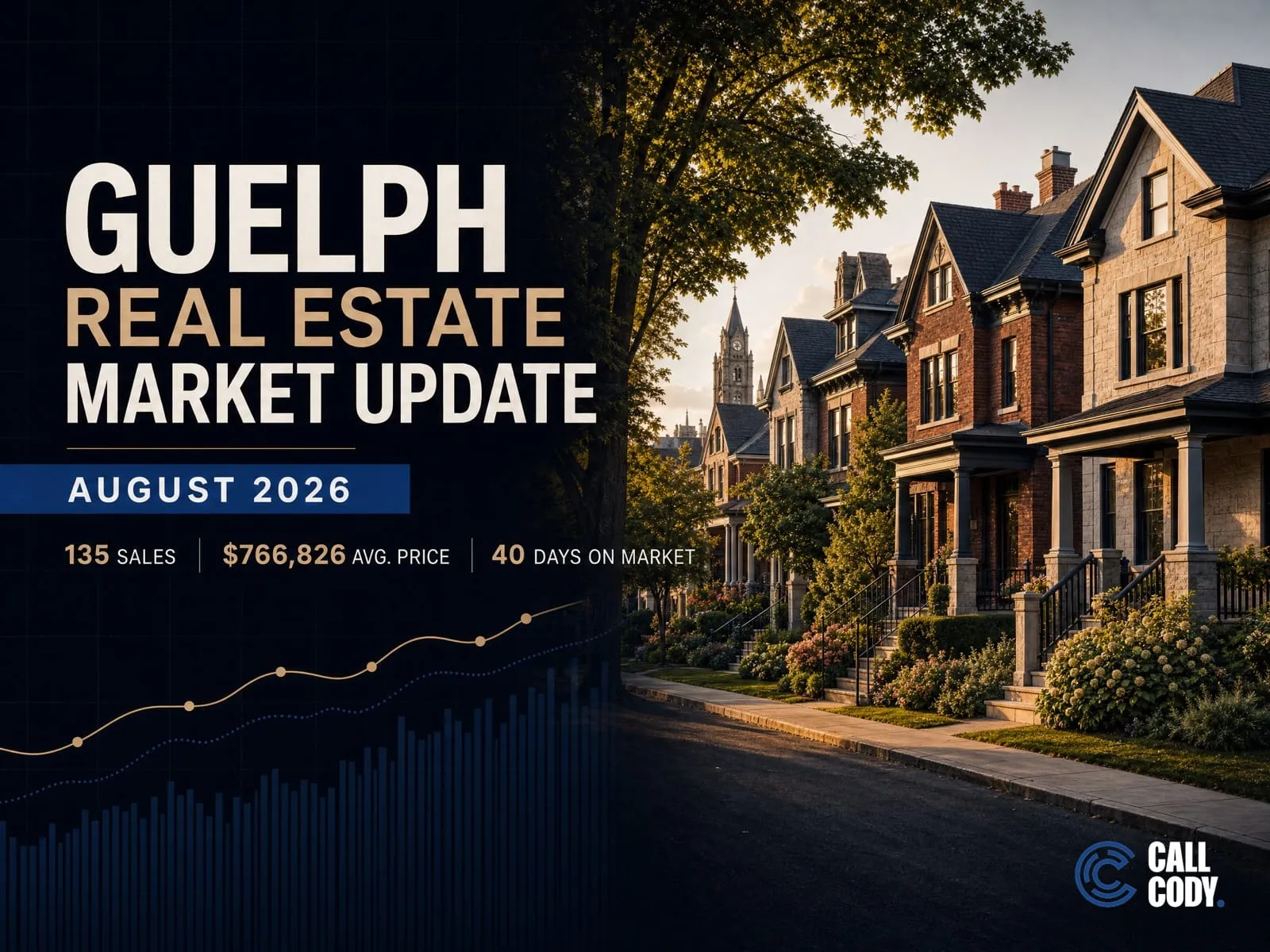
Rising fixed mortgage rates don’t flip a market on their own. Guelph’s market is shaped by local supply, pricing, and how long homes are sitting, and I track those factors every month. You can see where things stood in my Guelph real estate market update for August 2026. For the bigger picture, check my breakdown of whether Guelph is a buyer’s market or a seller’s market in 2026.
What higher fixed rates do is change the math at the margins:
- Buyers with tight approvals may find their price range has shifted a little since summer.
- Sellers should expect that some buyers’ budgets have shrunk slightly, which matters most when pricing at the edge of a common search band (for example, just over $800,000 versus just under).
- Everyone should remember that costs beyond the mortgage still add up. If you’re budgeting a purchase, my guide to Guelph real estate closing costs walks through the rest.
Your specific number depends on your income, down payment, and timing, and the only way to know for sure is to run it with someone who knows this market and a lender who knows your file.
Frequently Asked Questions
Fixed mortgage rates follow Government of Canada bond yields, not the Bank of Canada’s overnight rate. In September 2026 the 5-year bond yield climbed from 3.42% to 3.68% while the Bank of Canada held at 2.25%, so lenders raised fixed rates.
Yes. Federally regulated lenders qualify you at the greater of your contract rate plus 2% or 5.25%. When contract rates rise, the qualifying rate rises too, which lowers the maximum mortgage you can qualify for on the same income.
Not if you renew with your current lender. If you switch lenders at renewal without increasing your loan amount or amortization, OSFI does not require federally regulated lenders to apply the minimum qualifying rate to that uninsured straight switch.
The next scheduled announcement is October 28, 2026, followed by December 9, 2026.
If you’re buying or renewing in Guelph or Centre Wellington this fall, the rate on your approval matters more than the rate in the headlines. If you’d like to talk through what this means for your price range or your home, book a buyer meeting, check what your property is worth, or just reach out anytime — I’m happy to walk you through the numbers.
About Cody St. Jacques
Cody St. Jacques is a real estate agent in Guelph, Ontario with over a decade of experience and 1,000+ transactions across resale and preconstruction. Backed by great mentors and a full team of industry experts, he’s built his reputation on honest, no-hype advice that buyers and sellers trust during one of the biggest decisions of their lives. Whether you’re buying or selling in Guelph and the surrounding area, Cody focuses on one client at a time — guiding you through the market and the process from start to finish.

Sources: Bank of Canada policy rate announcement, September 2, 2026; Bank of Canada 5-year benchmark bond yield series (BD.CDN.5YR.DQ.YLD), as of September 28, 2026; Canadian Mortgage Trends, September 29, 2026; OSFI, Minimum Qualifying Rate for Uninsured Mortgages (page updated January 29, 2026). Payment examples are illustrative, calculated with Canadian semi-annual compounding, and are not a rate quote.

Looking For Guelph Real Estate Market Clarity? Call Cody
Our team demystifies the market, clarifies real estate processes, and guides you hands-on to your goals.