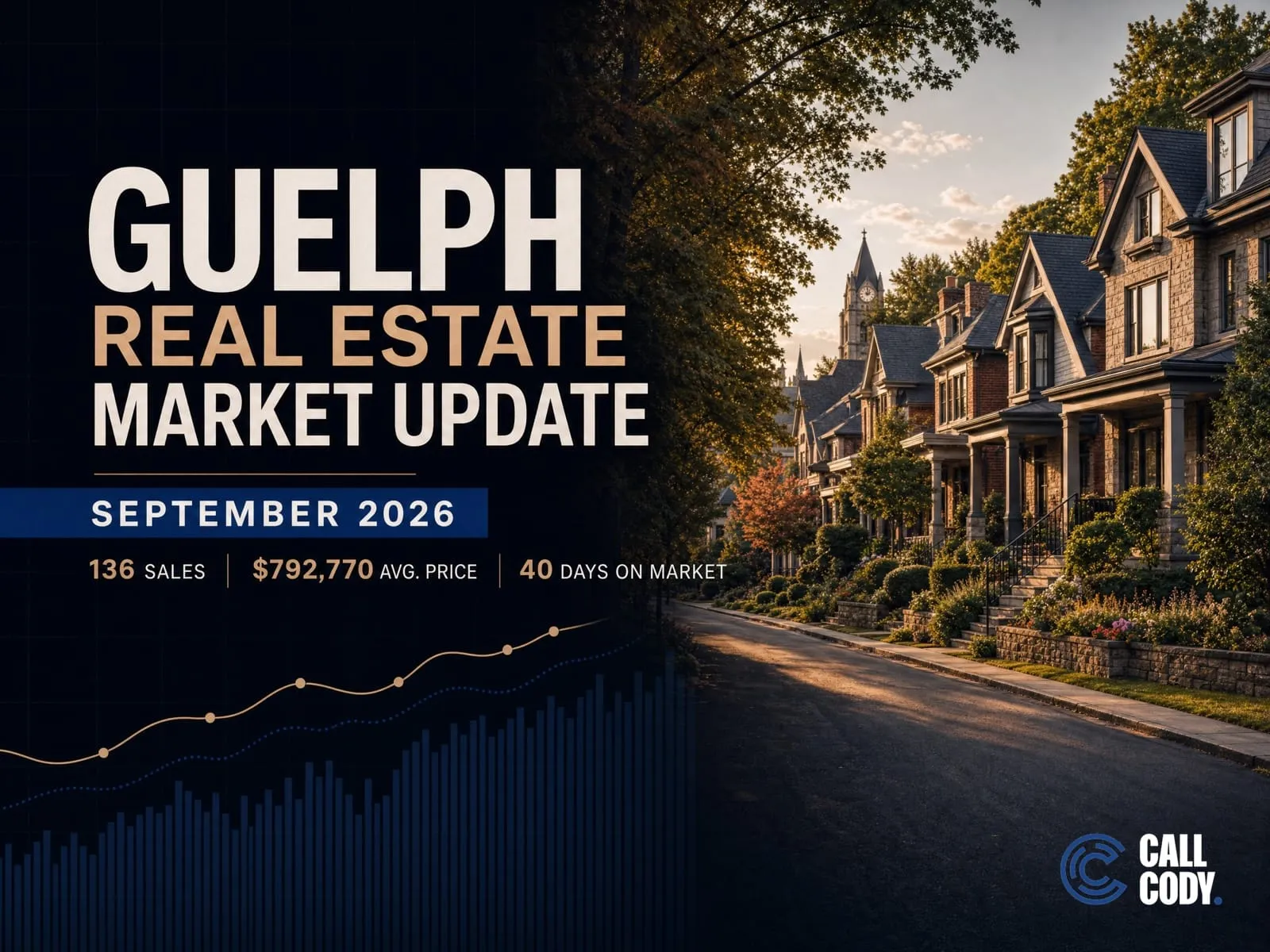




As of July 2026 MLS data, Guelph is best described as a balanced market leaning toward buyers — not a clear-cut buyer’s market. July’s sales-to-new-listings ratio sits at 43.3%, which falls inside the range most analysts consider balanced (roughly 40–60%), but on the lower, buyer-leaning half of that range. Median home price is down 2.6% year-over-year to $720,000, sales fell 11.3% to 149 homes, and the median home took 31 days to sell (40 days on average) — up from 23 and 32 days a year earlier. That combination gives buyers modestly more room to negotiate while still requiring sellers to price realistically. It’s a real shift, but a measured one, not a dramatic correction.
By Cody St. Jacques | August 2026
If you’ve been watching Guelph real estate headlines this year, you’ve probably noticed the tone has changed. It’s not the frantic, multiple-offer market of a few years ago, and it’s not a buyer’s free-for-all either. It’s something more nuanced — and honestly, more workable — for people who actually need to make a move.
Here’s what’s really happening, and what it means depending on which side of the transaction you’re on.
Is Guelph a Buyer’s Market or Seller’s Market in 2026? What the Numbers Actually Show
The most recent MLS data available for Guelph, through July 2026, looks like this:
- Median sale price: $720,000, down 2.6% from $739,500 in July 2025
- Average sale price: $764,108, down 1.8% from $778,209 in July 2025
- Unit sales: 149 homes sold, down 11.3% from 168 a year earlier
- New listings: 344, down 12.7% from 394 in July 2025 — fewer new listings hit the market than last year, not more
- Sales-to-new-listings ratio: 43.3%
- Days on market: 31 days (median), 40 days (average) — up from 23 and 32 days in July 2025
That sales-to-new-listings ratio is worth explaining, because a single number gets thrown around a lot in market commentary. The rough convention most analysts use: below 40% typically signals a buyer’s market, 40–60% is considered balanced, and above 60% favours sellers. At 43.3%, July reads as balanced with a lean toward buyers — not the kind of market where sellers can name their price, but not a steep buyer’s market either. A full read on local conditions also depends on active inventory and months of supply, which a simple monthly ratio doesn’t capture on its own. This is the clearest data point yet on whether Guelph is a buyer’s market or a seller’s market in 2026.
What supports the buyer-leverage argument more directly than the ratio itself is the sales decline: 149 homes sold in July versus 168 a year ago, an 11.3% year-over-year drop. Fewer completed sales against a shrinking pool of new listings is a sign of slower absorption, and that’s what’s giving buyers a bit more breathing room and giving sellers a market that rewards realistic pricing over wishful pricing.
This is one of the most common questions I get right now, from buyers and sellers alike: is this the start of a bigger correction, or just a market catching its breath after a few overheated years? Every situation is different, and the honest answer depends on your price point, your neighbourhood, and your timeline — that’s where a proper local market read comes in, not a headline ratio.
What This Means If You’re Selling
A market that’s balanced and buyer-leaning – the honest answer to is Guelph a buyer’s market or seller’s market in 2026 – doesn’t mean your home won’t sell.. It means it needs to compete on price, condition, and presentation in a way it didn’t have to during the boom years.
A few things I’m telling every seller who asks me about listing right now:
- Price it to today’s market, not last year’s market. With the median sale price down 2.6% year-over-year, the biggest mistake I’m seeing is sellers anchoring to a number from 2022 or even mid-2025. Homes priced accurately from day one are still moving in a reasonable window. Overpriced homes are the ones that sit well past the current 31-day median and eventually need a price cut.
- Expect a bit more negotiation than a year ago. With sales down over 11% year-over-year, buyers aren’t racing to beat out five other offers the way they might have in 2021 or 2022. You should go in expecting requests for repairs, closing flexibility, or a small price adjustment after inspection more often than you did last year — that’s normal in this environment, not a sign something’s wrong with your home.
- Presentation matters more when buyers have options and more time. With days on market up from 23 to 31 (median), buyers aren’t feeling rushed. Small things — decluttering, minor repairs, professional photos — start to matter more when a buyer can afford to keep looking.
- You still don’t need a mandatory disclosure form to sell in Ontario. Ontario doesn’t require sellers to complete a Seller Property Information Statement (SPIS) in most transactions, and most agents actually recommend against it for liability reasons. What you do have is a common-law duty not to conceal known latent defects — issues you know about that a buyer couldn’t reasonably discover on their own. Your real estate lawyer can walk you through exactly where that line sits for your property.
If you’ve been putting off preparing your home for sale hoping the market swings back in your favour, this is worth a closer look. I’ve written before about preparing to sell your home in Guelph, and most of that advice matters even more in a market where buyers have a little more time and choice.
Your specific number — what your home will actually net after commission, legal fees, and Ontario Land Transfer considerations on your next purchase — depends on your home’s condition, location, and timing. That’s exactly the kind of math I walk sellers through before we even talk about listing.
What This Means If You’re Buying
If you’ve been priced out of Guelph in the last few years and are wondering whether Guelph is a buyer’s market or a seller’s market in 2026, this is more negotiating room than buyers have had in a while — even if it’s not a dramatic swing.
Here’s what today’s conditions actually give you as a buyer:
- A market that isn’t racing away from you. With sales down 11.3% year-over-year and days on market stretching out, you’re less likely to feel like you have to make a snap decision on the first home you see.
- More room to negotiate. Conditions on financing and home inspection are easier to include in your offer than they were during the bidding-war years. That matters — a home inspection condition is one of the best protections you have as a buyer in Ontario, and it’s worth using when the market allows it.
- Less pressure to waive due diligence. You’re less likely to feel forced into a firm, no-conditions offer just to compete. That said, well-priced, well-located, move-in-ready homes are still moving in a median of about a month, so don’t assume every listing will sit indefinitely.
- A good time to run the real numbers. With prices down slightly year-over-year and a bit more time to make decisions, this is a solid window to sit down and figure out what you can actually afford at today’s rates, including closing costs and Ontario Land Transfer Tax, before you start touring homes.
One thing that hasn’t changed: you’ll still work with a real estate lawyer to close in Ontario, not a title company. Budget for that, along with your Land Transfer Tax and any home inspection costs, when you’re figuring out your total cash needed to close — not just your down payment. I go through the fuller cost breakdown, including these line items, in my post on Guelph real estate closing costs.
If you’re weighing a specific neighbourhood, it’s also worth understanding what’s happening street by street rather than just city-wide — I’ve broken down some of that detail in top neighbourhoods in Guelph.
A Quick Note on Fergus, Elora, and Guelph’s Zoning Rules
Two developments worth knowing about, even though neither changes today’s market conditions directly.
First, Guelph’s Comprehensive Zoning Bylaw appeal reached a partial settlement with the Ontario Land Tribunal in March 2026, which the City publicly announced on June 8, 2026. The settlement clarifies 57 of the appealed provisions — things like building lengths, parking rates, buffer strips, and bicycle parking requirements. It’s only a partial settlement; several city-wide and site-specific appeals are still outstanding. It should reduce some uncertainty and may make it easier to advance certain housing projects, including secondary suites and condo developments, but it doesn’t guarantee faster approvals across the board. It’s unlikely to move ordinary resale pricing in the near term, but it’s worth knowing about if you’re evaluating a property’s development potential, an infill site, or land with redevelopment upside.
Second, if Fergus or Elora is on your radar instead of Guelph proper, know that Centre Wellington’s growth story is more layered than a single headline number. Council approved a roughly 30% increase to development charges on new construction in March 2026, though the previous rates were temporarily frozen for six months — the current schedule is set to expire October 1, 2026. In June, the township also discussed an approach that could reduce calculated residential development charges by an estimated 30% in order to qualify for provincial funding, though that funding isn’t guaranteed, which makes the future charge picture less straightforward than “charges are rising.”
Separately, council has endorsed a set of recommended settlement area boundary expansions — roughly 132 hectares for community uses and 194 hectares for employment uses — though this is an endorsed plan, not a finalized, built-out expansion yet. If new construction in Centre Wellington is on your list, both the development-charge timeline and the boundary planning process are worth tracking closely with your builder or agent rather than assuming today’s numbers are locked in. I covered the broader growth story in Fergus real estate forecast, and it’s a good next read if that area is where you’re focused.
Guelph, Fergus, and Elora don’t always move in lockstep, and that’s exactly why a city-wide headline doesn’t tell you everything you need to know about your specific street or price range.
Right now, the answer to is Guelph a buyer’s market or a seller’s market in 2026 is: neither, cleanly — it’s a market that rewards people who make decisions based on where things actually stand – not where they stood two years ago, and not based on a single ratio pulled from one month’s data. Sellers who price to today’s conditions are still finding buyers in a reasonable window. Buyers who’ve been waiting for a bit of breathing room finally have some, even if it’s more modest than the headlines might suggest.
Your situation — your price point, your timeline, whether you’re buying, selling, or doing both — is going to look different from these city-wide averages. If you’re thinking through what this actually means for you, I’m happy to run the numbers and walk you through it. Reach out anytime, or request a free home value and market snapshot for your specific property.
Frequently Asked Questions
Is Guelph a buyer’s market in 2026?
Not exactly — July 2026 data puts Guelph in balanced territory, leaning slightly toward buyers. The sales-to-new-listings ratio was 43.3%, inside the 40–60% range most analysts consider balanced, though below the midpoint. Median price is down 2.6% year-over-year and sales fell 11.3%, which does give buyers more room than a year ago, but it’s not a steep buyer’s market.
Should I sell my house now or wait for the Guelph market to improve?
It depends on your timeline and your home’s specific position, but waiting isn’t automatically the safer choice. Homes priced accurately for today’s market are still selling in a reasonable window (a median of 31 days as of July 2026), while sellers who wait and then overprice tend to sit longer and eventually cut price anyway. A local market analysis for your specific property is the only way to know which situation applies to you.
How much are home prices down in Guelph in 2026?
As of July 2026, the median sale price was $720,000, down 2.6% from $739,500 in July 2025, and the average sale price was $764,108, down 1.8% from $778,209 the year before. Prices vary significantly by neighbourhood, property type, and condition, so a city-wide figure won’t tell you what a specific home is worth.
Does Guelph’s zoning bylaw settlement affect home buyers and sellers directly?
Not in a major way for most resale buyers and sellers. The Ontario Land Tribunal partial settlement, reached in March 2026 and announced by the City on June 8, 2026, clarifies development rules for builders and reduces some uncertainty, but it doesn’t guarantee faster approvals and several appeals remain outstanding. It’s more relevant if you’re evaluating a property’s future development potential, an infill lot, or land with redevelopment upside.
Is now a good time to buy in Fergus or Elora instead of Guelph?
Fergus and Elora’s growth picture is still evolving. Centre Wellington approved a roughly 30% development-charge increase on new construction in March 2026, with the current schedule set to expire October 1, 2026, and council has separately endorsed, but not yet finalized, a settlement area boundary expansion. If new construction in Centre Wellington is on your list, it’s worth discussing the current timeline with your builder or agent rather than assuming today’s numbers will hold.
If you’re thinking through this for your own situation, I’m happy to walk you through the numbers. Reach out anytime.
About Cody
Cody is a real estate agent serving Guelph, Ontario and Wellington County, working with buyers and sellers across Guelph, Fergus, and Elora. He focuses on straightforward, no-hype advice grounded in current local market data, helping clients make confident decisions whether they’re buying their first home, selling in a shifting market, or navigating new construction in a fast-growing community. Whether you’re buying or selling in Guelph and the surrounding area, Cody works with you directly, guiding you through the market and the process from start to finish.

Looking For Guelph Real Estate Market Clarity? Call Cody
Our team demystifies the market, clarifies real estate processes, and guides you hands-on to your goals.