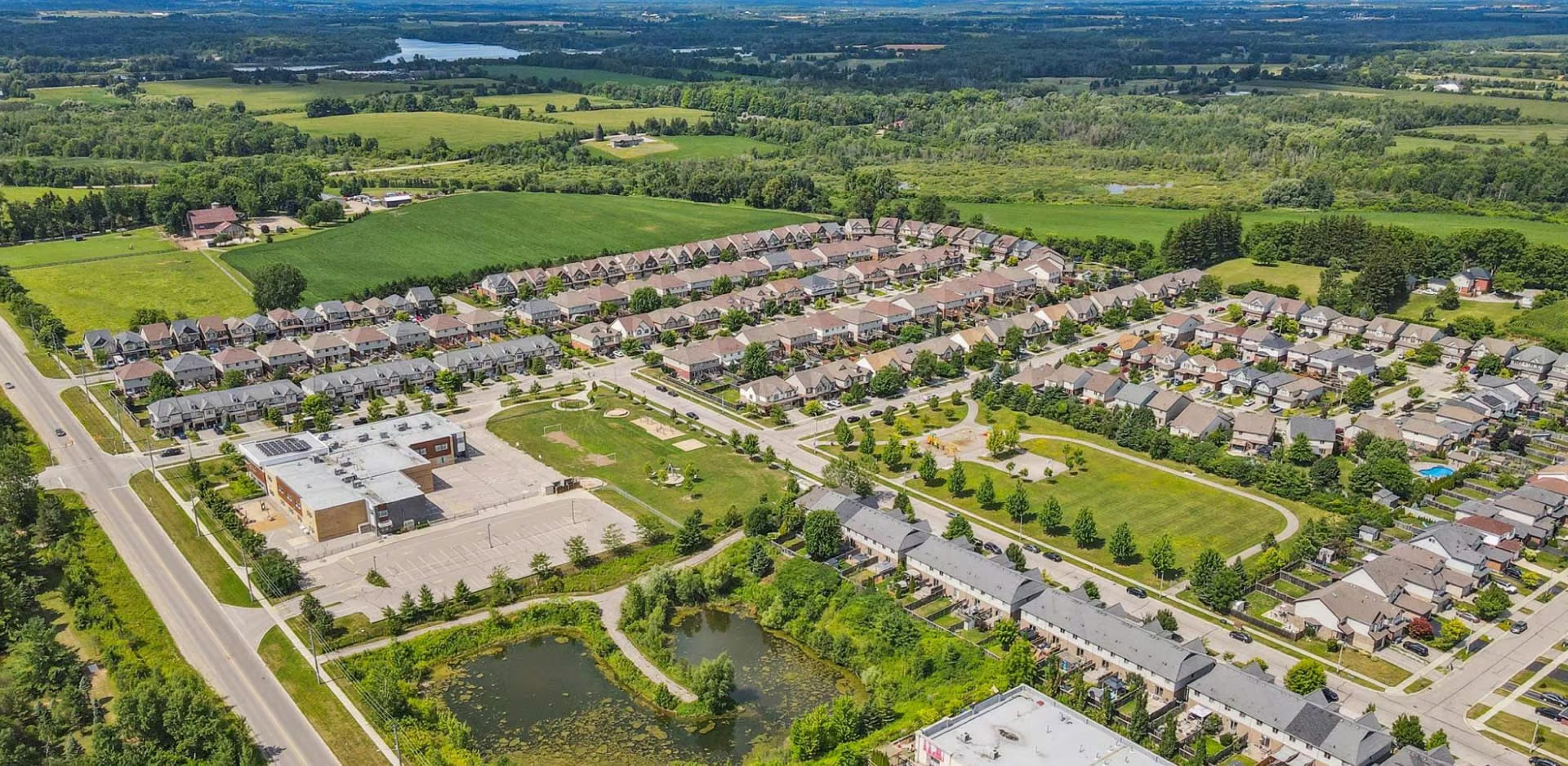



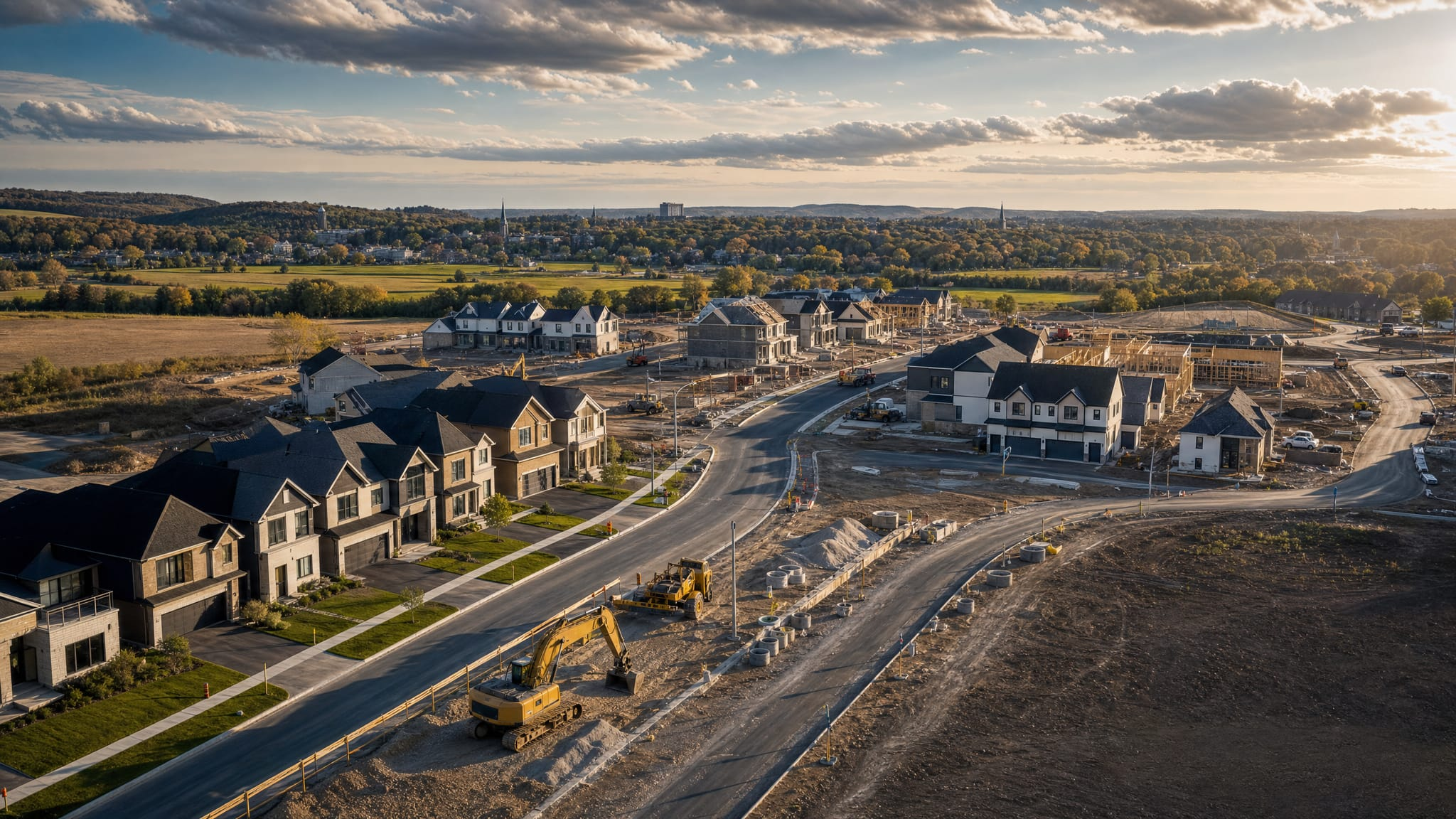
Centre Wellington development charges rose roughly 23% for single and semi-detached homes. Township council approved the new bylaw in March 2026, with steeper increases for apartments. The new rates aren’t landing all at once, though. Council froze charges at the old levels for six months after approval. Full rates won’t take effect until April 2027. That increase will still work its way into the purchase price of new construction in Fergus and Elora. It’s one of the clearest signs yet of how fast this corner of Wellington County is growing. If you’re shopping new construction here, or weighing whether to sell land or an existing home, this market is moving. Understanding what’s changing — and when it actually hits — should shape your next move.
By Cody St. Jacques | September 15, 2026
Centre Wellington isn’t growing by accident. The Province of Ontario has directed the township to plan for roughly 60,000 residents over the next 25 years. That’s more than double its current population. That mandate is reshaping everything from water infrastructure to the price tag on a new build in Fergus or Elora.
Development charges are the mechanism municipalities use to make new growth pay for itself. They fund roads, water and wastewater capacity, parks, and recreation facilities. When the province directs a township to grow this fast, those charges climb. Builders then pass them straight through to the purchase price. That’s exactly what happened here.
I’ve been fielding more questions about this from buyers and landowners in Centre Wellington than almost anything else this year. Here’s what the increase actually means depending on which side of the transaction you’re on.
Why Centre Wellington Development Charges Are Rising
The short version: growth costs money, and the township has to collect it somewhere.
What Centre Wellington’s Development Charges Bylaw Actually Changed
Centre Wellington council approved its new development charges bylaw on March 23, 2026, just before the previous bylaw expired. According to reporting from GuelphToday, the approved schedule raises the residential development charge roughly 23% for single and semi-detached homes. Apartments saw steeper hikes: 32% for bachelor and one-bedroom units, and 54% for larger units. Council didn’t apply the new rates right away, though. It froze development charges at the old rates for six months. It also added a temporary 25% exemption for projects in designated intensification and density areas. Council is phasing in the full new rates between October 2026 and April 2027. Those numbers are lower than earlier reporting had projected. An earlier background study had estimated an increase of roughly 30%, or $36,000 to $48,000. Development charge estimates can shift before council takes a final vote.
That’s not a one-off cost grab. Centre Wellington’s mayor, Shawn Watters, has been candid about the position the township is in. The province has set the growth target, he says. The township’s job is managing how — not whether — that growth happens. “We can’t say no,” he told the Advertiser, “but we can participate in the conversation.”
At the March 2026 meeting where council approved the new bylaw, chief administrative officer Dan Wilson put it plainly: “It is a fairly substantial increase … but, to be perfectly honest, this is the cost of growth.” He added that if developers and new homeowners don’t cover that cost, someone still has to. Property taxpayers and water and wastewater ratepayers end up paying it instead.
Where Centre Wellington’s Development Charges Money Is Going
To support that growth, the township has also been investing ahead of demand. It has acquired the Middlebrook well to secure future water capacity. It has also purchased 91 acres beside the Fergus Sportsplex for future recreation facilities. Those are the kinds of infrastructure costs development charges are designed to fund.
There’s a pressure-release valve built in, too. Builders constructing homes priced within 20% of the province’s affordability threshold — around $430,000 — can defer development charges over six years. That means they don’t have to pay them up front. That’s aimed at keeping some entry-level supply moving even as costs climb. Still, it does little to soften pricing at the $500,000–$1,000,000 level most Fergus and Elora buyers are shopping in.
What This Means If You’re Buying New Construction in Fergus or Elora
This matters if you’re comparing a new build in Fergus or Elora to a resale home. The development charge increase is part of why that gap may feel wider than it used to.
A few things worth knowing before you sign a new construction agreement:
- Ask when the builder’s project locked in its development charge rate. Centre Wellington froze charges at the old rates for six months after approving the new bylaw in March 2026. It then began phasing in the increase between October 2026 and April 2027. Some projects may still be working under the lower, older charge — which can matter for pricing and value.
- Get clarity on what’s included in your purchase price versus what shows up as closing adjustments. Development charges are typically baked into the builder’s price. Other municipal levies and utility hookup costs sometimes appear as adjustments at closing instead. Your real estate lawyer should walk through this with you before you close.
- Factor in Tarion new home warranty coverage when comparing a new build’s total cost to a resale property. It’s a real value-add, but it’s also part of what you’re paying for.
- Remember that Ontario Land Transfer Tax applies on top of your price, whether the home is new or resale. Build that into your total closing cost picture early — not the week before closing.
None of this means new construction in Fergus or Elora is a bad move. Centre Wellington is one of the fastest-growing communities in this region — you can read more about the growth forecast for Fergus here. It does mean the math looks different than it did two years ago, and your offer strategy should reflect that.
What This Means If You’re Selling or Sitting on Land
If you own land in Centre Wellington, or you’re selling an existing home, this shift works in your favour. Your home will now be competing against pricier new construction, and that helps in a couple of ways.
Rising development charges push new-build pricing up. That tends to make well-priced resale inventory look more attractive by comparison. This is especially true for buyers who are already stretched by financing costs. Many don’t want to absorb a higher new-construction price on top of it.
If you own undeveloped or underdeveloped land, the calculus around holding versus selling now involves more than just land value. A buyer or builder evaluating your property is going to run the development charges into their feasibility numbers. That affects what they can reasonably offer. Understanding where those numbers land before you list puts you in a much stronger negotiating position. Finding out after an offer comes in low puts you at a disadvantage.
This is also playing out against the backdrop of Guelph’s own market conditions. Those conditions have been running closer to balanced than they were a year or two ago. Buyers across the region have more room to be selective right now, which is exactly why pricing strategy — whether you’re selling a resale home or land — matters more than it did in a tighter market.
If you’re weighing whether to sell now, hold, or explore a development or severance opportunity, have that conversation early. It’s worth doing before you make a move, not after.
The Bigger Picture: Zoning Is Shifting Too
Development charges aren’t the only regulatory change affecting how — and how fast — Centre Wellington and Guelph can build. The City of Guelph announced a partial settlement at the Ontario Land Tribunal in June 2026. It resolved 57 of the provisions that had been under appeal since the Comprehensive Zoning Bylaw passed. City planning staff say the new rules add clarity on building lengths, parking rates, and buffer strips. That clarity should make it easier to build housing, from in-law suites to backyard homes. Several city-wide provisions and five site-specific appeals are still working their way through the process, though.
Both what can be built, and what it costs to build it, are moving targets in this region right now. That’s worth remembering. That’s true whether you’re evaluating a new construction purchase or thinking about adding value to a property you already own. It’s also true if you’re simply deciding when to list. For a broader look at how Guelph’s market has been moving lately, see the latest monthly market update.
Your specific numbers depend on details that don’t show up in a general market post like this one. That includes what a development charge increase means for the new build you’re considering. It also includes what your land or existing home is worth in this shifting market. That’s the kind of thing worth running through with someone who’s tracking these changes as they happen. It’s better to do that now, not after the fact.
Frequently Asked Questions
Centre Wellington development charges rose roughly 23% for single and semi-detached homes under a bylaw council approved in March 2026. Apartments saw steeper increases — 32% for bachelor and one-bedroom units, and 54% for larger units. Council froze charges at the old rates for six months. It then began phasing in the increase between October 2026 and April 2027. The exact charge a buyer pays depends on when the builder’s project was approved.
No. Development charges are collected from builders and developers on new construction and new development. They aren’t collected on the resale of existing homes. They do, however, influence new-build pricing, which affects how resale homes compare in the local market.
Builders pricing homes within roughly 20% of the province’s affordability benchmark — around $430,000 — can defer development charges over six years. That means they don’t have to pay them upfront. This mainly affects entry-level product. It has limited impact on pricing in the $500,000–$1,000,000 range most Fergus and Elora buyers are shopping in.
More Questions About Centre Wellington Development Charges
They’re separate processes in separate municipalities. Both reflect the same underlying pressure: this region is growing quickly. Zoning rules and development charges are simply the tools local governments use to manage that growth. Guelph announced a partial Ontario Land Tribunal settlement on its Comprehensive Zoning Bylaw in June 2026. Centre Wellington’s development charges are rising separately, on their own phased-in timeline, under its own bylaw review.
There’s no way to predict future development charge schedules with certainty. Waiting on the assumption that costs will drop isn’t a strategy I’d recommend. It’s more useful to evaluate today’s numbers against your budget and timeline. It also helps to factor in Centre Wellington’s ongoing infrastructure growth. That growth is likely to keep driving both charges and demand upward over time.
If you’re thinking through what this means for your own purchase, your land, or your next move in Fergus, Elora, or Guelph, I’m happy to walk you through the numbers. Reach out anytime.
About Cody St. Jacques
Cody St. Jacques is a real estate agent in Guelph, Ontario with over a decade of experience and 1,000+ transactions across resale and preconstruction. Backed by great mentors and a full team of industry experts, he’s built his reputation on honest, no-hype advice that buyers and sellers trust during one of the biggest decisions of their lives. Whether you’re buying or selling in Guelph and the surrounding area, Cody focuses on one client at a time — guiding you through the market and the process from start to finish.


Looking For Guelph Real Estate Market Clarity? Call Cody
Our team demystifies the market, clarifies real estate processes, and guides you hands-on to your goals.