


What is Guelph’s Vacant Home Tax and how does it affect sellers?
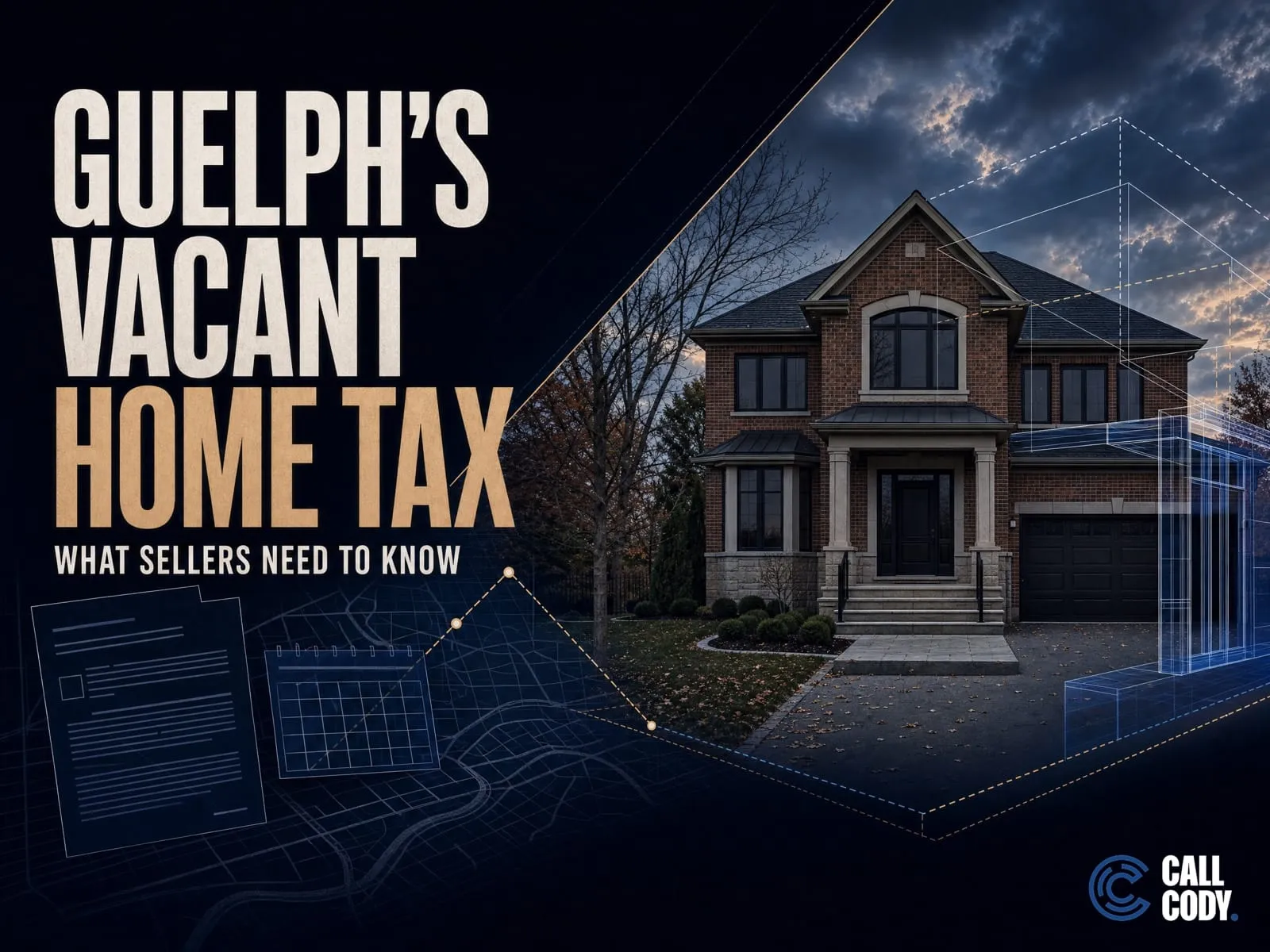
Guelph’s Vacant Home Tax took effect January 1, 2026. It charges 4% of a property’s MPAC-assessed value. That applies to any residential home left unoccupied for more than 183 days in the year. Unlike Toronto’s system, Guelph doesn’t require self-declaration. The city identifies vacant properties through complaints and its own records, then investigates. For sellers, the tax mostly matters when a property has sat empty heading into year-end. That could be an estate, a between-tenants investment unit, or a spec-built home. A “recently sold” exemption protects you in the year you actually close.
By Cody St. Jacques | September 30, 2026
Are you selling a property that’s been sitting empty? Maybe it’s an inherited home, an investment property between tenants, or a house you moved out of before listing. Either way, Guelph’s new Vacant Home Tax is worth understanding before you list — not after you get a notice in the mail.
This is a brand-new program. It only started January 1, 2026, and most homeowners in Guelph have never dealt with anything like it before. Toronto and Ottawa have run similar taxes for a few years now. If you’ve sold in one of those markets, some of this will feel familiar. Guelph’s version has its own rules, though, and they’re worth knowing exactly.
What the tax actually charges you
The Vacant Home Tax applies a 4% levy on your property’s current assessed value. MPAC — the Municipal Property Assessment Corporation — determines that value, not the sale price or market value. That number shows up as a line item on your property tax bill.
To put that in perspective: a home assessed at $500,000 would add $20,000 to your tax bill. That’s for a full year of vacancy. It’s a meaningful number, and it’s designed to be. The policy exists to push empty homes back into Guelph’s housing supply, not to raise general revenue. Money collected goes into the city’s Affordable Housing Reserve Fund once administrative costs are covered.
A home counts as vacant under the bylaw if it’s unoccupied for more than 183 days in a calendar year. That’s roughly six months. It applies whether no one lives there, it isn’t rented out, or it isn’t used as anyone’s principal residence.
How Guelph decides a home is vacant — and who’s exempt
Here’s where Guelph’s approach differs from Toronto’s or Ottawa’s in a way that matters for sellers. Guelph doesn’t require every homeowner to file an annual declaration proving their home is occupied. Instead, the city launched an online reporting form in July 2026. It lets anyone flag a suspected vacant property, and the city also cross-references its own records. Once a property is flagged, the city contacts the owner. The owner must then complete a notice of declaration with supporting documents — utility bills, lease agreements, that kind of proof.
Practically, that means the properties most likely to get flagged are the ones that look obviously vacant. Think no visible activity, uncut lawns, no vehicles, or mail piling up. A tip from a neighbour or a buyer’s agent doing due diligence can flag a property too.
Several categories of properties are exempt, even if they sit empty for more than 183 days:
- Principal residences occupied at least 183 days of the year
- Homes undergoing major renovations, for up to one year
- Homes of a deceased owner, for up to 24 months from the date of death
- Recently sold properties, exempt for the year of sale
- Homes where the owner is hospitalized or in care, for up to 24 months
- Social and affordable housing units
- New builds not yet listed for sale or rent, for up to one year
- Redevelopment sites with an active site plan application, for up to two years
That “recently sold” exemption is the one sellers should pay closest attention to. Selling a vacant home in the year you close doesn’t, by itself, trigger the tax for that year. The risk shows up in the year before you sell. If the property sat empty long enough, it can cross the 183-day threshold before it ever went on the market.
What this means if you’re listing a vacant property
Are you planning to sell a home that’s been unoccupied for part or all of this year? A few things are worth doing before you list:
- Confirm the property’s status directly with the City of Guelph. The exemption categories are specific. Whether an inherited home, a vacant rental, or a spec-built house qualifies can depend on specific documentation. You’ll want that in hand before closing, not scrambling for it after.
- Keep records. Utility bills, a property management agreement, renovation permits, or a lease that lapsed can all support an exemption claim. Keep them on hand in case the city investigates.
- Time your listing with the calendar in mind. A property vacant from March through October, for example, has already crossed the 183-day threshold well before a fall closing. The “recently sold” exemption only covers the year of the actual sale.
- Expect buyers to ask. More buyer’s agents are now asking about vacant home tax status on investment properties and visibly empty homes. It’s becoming part of due diligence, the same way they’d ask about outstanding work orders or a property’s rental history. Having a clear answer builds confidence and avoids last-minute questions during conditions.
This is a newer part of the process compared to how the city handles zoning and unit counts on residential lots. But it fits the same pattern. Guelph is actively working to get more homes occupied and more housing supply into circulation. The vacant home tax is one more lever the city is using to do it.
I walk sellers through this kind of thing regularly, especially with estate sales and investment properties. Often, a home sat empty for reasons that had nothing to do with the market. It’s rarely as simple as “the house was empty, so I owe the tax.” But it’s also not something you want to find out about for the first time. That’s especially true after you’ve already listed. Are you preparing to sell a home in Guelph that’s been sitting vacant? It’s worth a conversation before your listing goes live.
Frequently Asked Questions
No. Homes occupied as a principal residence for at least 183 days in the year are exempt. The tax is aimed at properties that sit empty, not the home you actually live in.
Generally no — Guelph’s bylaw includes a “recently sold” exemption for the year a property changes hands. The risk is in prior years, if the home was vacant for more than 183 days before you listed it.
Guelph doesn’t require an annual self-declaration from every homeowner the way Toronto does. Instead, the city relies on public complaints through an online reporting form (launched July 2026) and its own records, then contacts the owner and requests documentation if a property is flagged.
The city has pointed to documents like utility bills and lease agreements as supporting evidence. If you’re claiming an exemption — for a recent sale, a renovation, or an estate — keep the relevant paperwork on hand.
It’s based on the MPAC assessed value, not the sale price or current market value. Those two numbers can differ significantly in a market like Guelph’s, so don’t assume your sale price is the number the tax would apply to.
The city’s published materials don’t spell out a specific penalty schedule for failing to declare or for providing false information. If this applies to your situation, confirm directly with the City of Guelph’s property tax department before you list.
If you’re thinking through what this means for your property, I’m happy to walk you through it before you list. Reach out anytime.
About Cody St. Jacques
Cody St. Jacques is a real estate agent in Guelph, Ontario with over a decade of experience and 1,000+ transactions across resale and preconstruction. Backed by great mentors and a full team of industry experts, he’s built his reputation on honest, no-hype advice that buyers and sellers trust during one of the biggest decisions of their lives. Whether you’re buying or selling in Guelph and the surrounding area, Cody focuses on one client at a time — guiding you through the market and the process from start to finish.


Looking For Guelph Real Estate Market Clarity? Call Cody
Our team demystifies the market, clarifies real estate processes, and guides you hands-on to your goals.